RCS + Fallback
A built-in SMS/MMS fallback so no RCS message fails silently.
- My role
- Product Designer UX Writer
- Timeline
- Sep – Oct 2025
Context
Deliverability is key for marketers: every missed message is potentially a lost sale, and they may never know it. RCS is still new, and on customer and prospect calls we kept hearing the same thing — what happens if something goes wrong?
Project
Build a fallback that automatically delivers an SMS or MMS whenever RCS fails to reach a subscriber, unified within a single campaign so marketers can manage, measure and optimize everything in one place.
The process
- 1Empathize
- 2Define
- 3Ideate
- 4Prototype
- 5Test
Empathize
As we began to pitch the new RCS abilities to new and existing customers, a clear theme emerged — 1 in 6 customers brought up fallbacks independently, signaling that delivery was top of mind.
EmpathizeCHALLENGE 1
Unmet expectations.
Many customers assumed fallback functionality was already built in. Discovering it required additional setup was a disappointment — a baseline expectation we hadn't yet met, creating a trust gap during the sales process.
“We need to be able to have, like, fail state callbacks, webhooks on those messages in order for us to build logic to fall back to SMS and our other carrier. Figured that was a checkbox.”
“Your system already handles the fall over [from RCS to SMS]?”
“Is that [fallback] built into the system?”
EmpathizeCHALLENGE 2
Technical complexity.
Existing fallback options required a webhook configuration, a separate campaign and API knowledge most marketers didn't have. Without developer resources, fallbacks simply didn't get set up, leaving RCS campaigns exposed to silent delivery failures.
EmpathizeCHALLENGE 3
Lack of confidence.
RCS is still an emerging channel, and marketers trying it for the first time needed assurance that failed deliveries wouldn't mean lost customers. Without a visible, reliable fallback, the risk of silent failure made some hesitant to adopt RCS at all.
“Do all carriers support RCS messaging today, and what's the fallback if they don't support it?”
“Do you think there will be more chances of failure in terms of RCS compared to SMS?”
Define
Fallbacks weren't a nice-to-have; they were a baseline expectation, and the technical requirements were a barrier for the customers who needed them. The new flow had to solve three challenges at once: simplicity, expectation and confidence.
DefineUser Persona
Melissa is the face of our customer. She has a strong need to feel confident when she presses send—she needs to know that her messages are being delivered. Without a fallback option, she is uncertain who will get each message.
Ideate
During the ideation phase, I asked myself three questions.
IdeateHow Might We?
- Make it easy
Remove the need for technical resources and make fallbacks feel native to RCS, not an afterthought.
- Meet expectations
What do customers expect, and how do we get there?
- Build confidence
Where should it live so it's noticed, and how do we show it's working?
IdeateDecisions
Three decisions carried the flow from question to screen.
- A native toggle
The fallback had to feel native to RCS creation, not a separate campaign or panel.
- An SMS or MMS dropdown
Marketers expected choice. MMS is richer and closer to RCS but costs more; SMS is leaner and cheaper.
- An explanatory tooltip
Confidence was the hardest problem at the point of creation. A tooltip next to the fallback label explains what a fallback is and who will receive it.
Prototype
The final flow follows the marketer through three steps.
PrototypeStep 1: Discovering the toggle
The toggle lives at the bottom of the RCS creation panel. By the time marketers reach it, they know their RCS message well enough to decide what to preserve in a fallback.
PrototypeStep 2: Adding the fallback
Toggling it on expands the configuration options. Marketers pick SMS or MMS, then craft the fallback with the same image uploader and text editor they used for their RCS message.
PrototypeStep 3: Publish with confidence
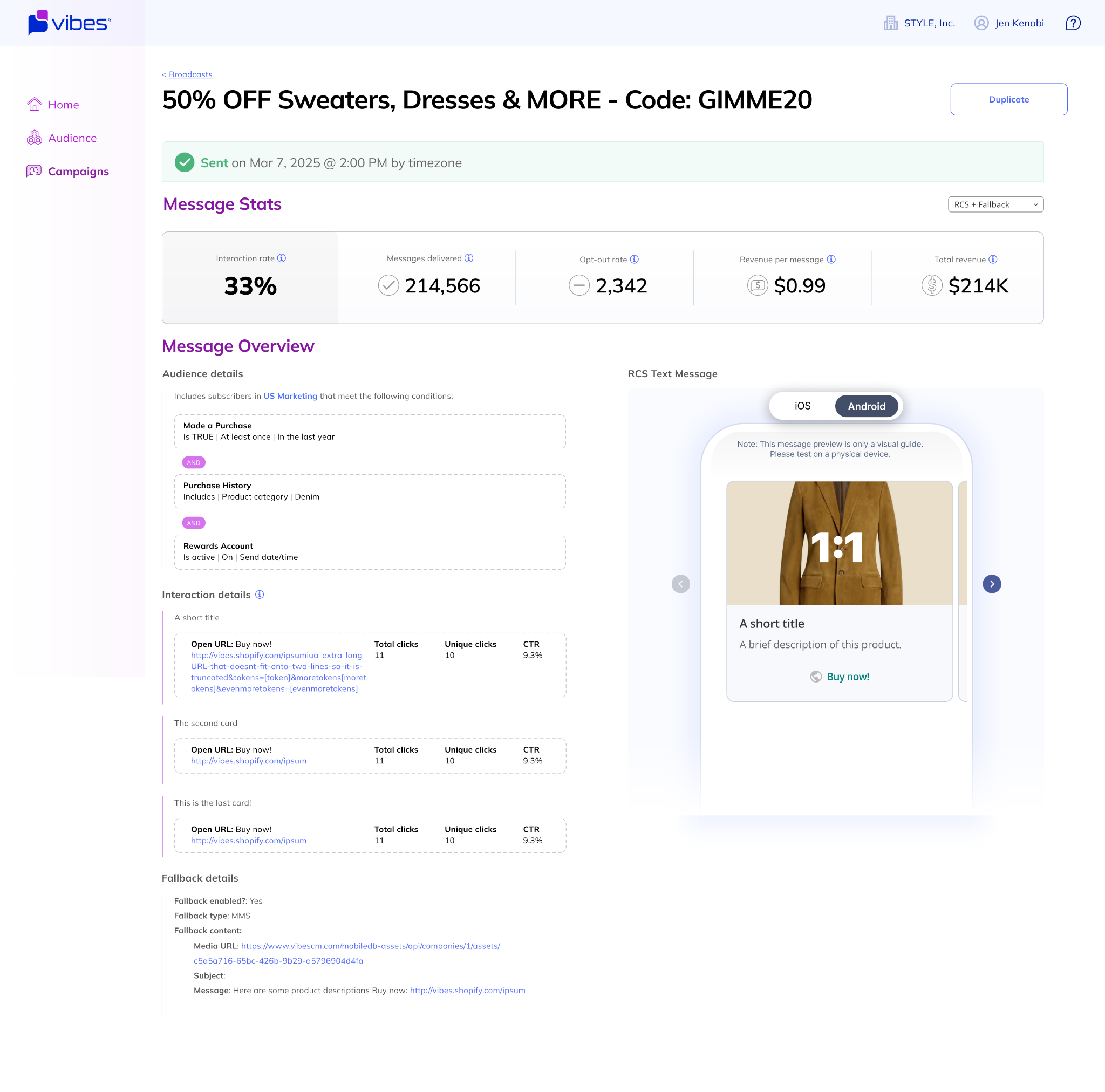
After publishing, the campaign details page has a new Fallback details section confirming it's set up — no webhooks, no API calls, no extra campaigns. A future iteration would add post-send reporting showing how many subscribers got the fallback versus full RCS.
Test
After my first iteration, I tested with potential users.
BEFORE TESTING
AFTER TESTING
After testing, users requested the ability to add both fallbacks—not just one.
BEFORE TESTING
AFTER TESTING
During testing, users noted that the content in the fallback was usually the same as in their RCS send. Having the content automatically populated in the fallback saved them additional work.
Wrap up
Wrap upResults
94.9%
RCS broadcasts included a configured fallback within first month.
[Placeholder]
[Placeholder] Second result for the fallback tool.